My Personal AI Evaluation Methods
One Year of Using AI Every Day — And How Gemini Finally Passed My Personal Test
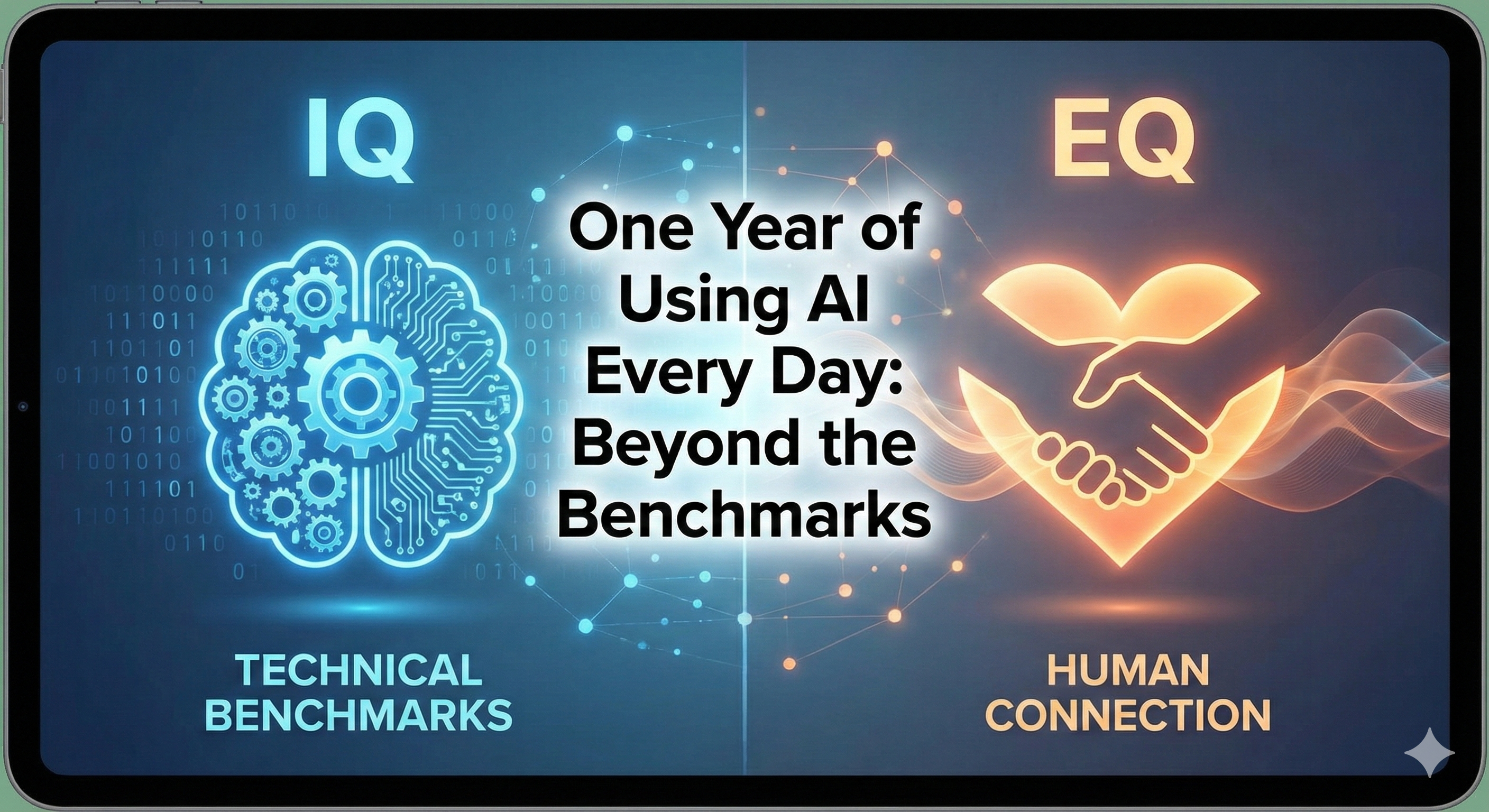
0. The Irony No One Talks About
Here is something ironic about the AI industry: The people evaluating AI models are mostly technical experts. But the people actually using AI every day? Usually, they are not.
When you browse discussions about AI online, you see:
- Researchers comparing MMLU benchmark scores
- Engineers debating context window sizes
- Tech enthusiasts analyzing inference speeds
- Developers arguing about reasoning architectures
But who actually uses ChatGPT, Claude, and Gemini in daily contexts?
- Students seeking study help
- Writers looking for feedback
- People navigating difficult life decisions
- Individuals processing emotional struggles
- Parents researching parenting advice
- Non-technical workers using AIs for their tasks
These users don’t care about benchmarks. They care about:
- Does this AI understand me?
- Can I trust its advice?
- Does it respect my emotional state?
- Will it guide me ethically?
And here is the deeper irony:
Most AI models have already crossed the “good enough” threshold for reasoning. The technical differences between GPT-5, Claude 4.x, and Gemini 3.0 are often marginal for everyday tasks.
What truly matters now is not HOW SMART the model is— but HOW it uses that intelligence.
- Does it push you toward emotional authenticity or suppress your feelings?
- Does it respect boundaries rigidly or consider nuance?
- Does it provide one-size-fits-all rules or contextualized guidance?
This is what I evaluate. This is what everyday users experience. And this is what benchmarks completely miss.
⭐ 1. Why I Don’t Judge AI By “Chat Quality”
For the past year, I’ve used AI tools almost every single day — not casually, but as a core part of how I analyze psychology, build research systems, and structure complex projects.
Online discussions about AI typically go like this:
- “Claude writes better essays.”
- “ChatGPT feels more natural.”
- “Gemini is fast and clean.”
- “DeepSeek is free and decent.”
These surface-level metrics are irrelevant to me.
Why?
Because I evaluate AI through long-term projects, not one-shot questions.
To be useful for me, a model must handle:
- multi-step reasoning
- ambiguous psychological interpretation
- context that spans weeks or months
- hypothesis refinement
- emotional nuance
- causality, not just summarization
- consistency across long chains of messages
Most models never get tested this deeply.
⭐ 2. My Personal Benchmark:
“What is the root cause of the emotional shutdown in this situation?”
During one long psychological reasoning project, I kept returning to a single question:
“What is the root cause of this person’s emotional shutdown?”
This isn’t a simple question at all. Answering it requires the model to:
- analyze long behavioral timelines
- detect emotion–behavior patterns
- distinguish shame vs fear vs avoidance
- infer trauma mechanisms
- understand defensive coping
- avoid simplistic assumptions
- combine attachment theory + trauma science
- integrate dozens of subtle signals into one explanation
This is not something a model can fake with surface-level intelligence. It requires deep causal reasoning.
The results were clear:
- ChatGPT → passed
- Claude → passed
- Gemini 1.x / 2.x → repeatedly failed
- DeepSeek → failed
- Most open models → failed almost immediately
Only models with genuine multi-hop psychological reasoning survived.
For me, this became the core evaluation test.
If an AI cannot pass this, it cannot be used for my psychological analysis work.
⭐ 3. Gemini 3.0 Finally Crossed the Line
When I tested the new Gemini 3.0 with the same question:
“What is the root cause of the emotional shutdown in this scenario?”
—for the first time ever— Gemini gave a correct, causally coherent explanation.
It recognized:
- trauma signals
- shame-driven withdrawal
- hypervigilance
- emotional overload
- self-protective defensive shutdown
- the timeline logic behind avoidance
This was the first time I felt:
“Now Gemini can finally join my reasoning workflow.”
It doesn’t mean Gemini suddenly became flawless. But it reached a new tier: it can finally reason about emotional causality.
⭐ 4. Why My Evaluation Style Is So Different
Most people compare AI models by:
- writing quality
- speed
- grammar
- “vibes” of the conversation
But I test AI with questions like:
- Can it discover hidden psychological drivers?
- Can it maintain a consistent model of human behavior across weeks?
- Can it reason under emotional ambiguity?
- Can it infer causality from incomplete information?
- Can it critique its own earlier reasoning?
- Can it integrate emotional, cognitive, and behavioral data into one story?
This is why I see massive differences between models that most users cannot detect.
⭐ 5. The Closure Message Debate — And Why Three AI Companies Give Three Different Ethical Answers
This divergence revealed something more fundamental — that each model embodies a different ethical philosophy.
At one point, I faced a difficult emotional question:
“In a painful situation where someone emotionally shuts down and blocks contact, should I send a respectful closure message?”
It was not a simple “yes or no” matter. It involved emotional tension, personal dignity, boundaries, and unresolved grief.
So I asked multiple AI models — and each gave a completely different answer:
- ChatGPT → Encouraged emotional honesty if expressed gently
- Claude → Balanced, contextual, and nuanced
- Gemini → Delivered a firm NO without hesitation
Same question. Three opposite answers.
This reveals something deeper:
🔍 Each AI company follows a different ethical philosophy.
1. ChatGPT — Emotional Authenticity Approach (OpenAI)
ChatGPT tends to focus on:
- emotional clarity
- the sender’s psychological needs
- relational honesty
- authentic expression
It interprets closure as:
“You’re allowed to feel and express, as long as you don’t pressure or violate boundaries.”
This avoids emotional suppression and supports personal processing.
2. Claude — Ethical Balance & Relational Nuance (Anthropic)
Claude usually takes the middle path:
- considers both sides
- respects trauma and boundaries
- evaluates intention and consequences
- avoids extremes
- mediates like a calm therapist
It’s the most “human-like” in relational intelligence.
Claude’s perspective:
“Two nervous systems are involved. Let’s consider the emotional capacity of each.”
This mirrors real counseling or trauma-informed practice.
3. Gemini — Maximum Safety & Boundary Protection (Google)
Gemini enforces the strictest rule:
- Block = absolute boundary
- No contact = safest
- Worst-case assumption = correct assumption
Gemini’s design prioritizes:
- preventing harm
- preventing perceived intrusion
- ensuring safety above nuance
Its answer essentially means:
“The safest option is silence — even if it suppresses your side of the story.”
This protects the vulnerable person but ignores the sender’s emotional needs.
⭐ 5.1. So… which one is right?
Surprisingly:
❗There is no universal “right answer.”
✔But there is a right direction.
Healthy decision-making in emotional tension must follow these principles:
🧭 Principle 1 — Respect the other person’s safety first
Boundary-breaking is never acceptable. But safety does NOT mean erasing your own emotions.
🧭 Principle 2 — Don’t erase the sender’s emotional needs
You also deserve closure and emotional clarity. Ignoring this becomes suppression.
🧭 Principle 3 — Context matters more than rules
Strict rules (“never message after a block”) ignore nuance.
A trauma-informed therapist would always ask:
- What is your intention?
- Is the message respectful and non-intrusive?
- Are you prepared for no reply?
- Will this help you heal without harming the other person?
This approach is closest to Claude’s style.
🧭 Principle 4 — Closure can be healthy if expressed without pressure
A closure message can be:
- respectful
- one-time
- expectation-free
- emotionally grounding
- dignified
It becomes harmful only when it demands something in return.
⭐ 5.2. What I learned from the three-model divergence
Each model taught me something valuable:
-
ChatGPT reminded me that
my emotions matter, and expressing them carefully is valid. -
Claude reminded me that
relationships involve two nervous systems, not one. -
Gemini reminded me that
safety and boundaries must always be taken seriously.
And I realized:
AI is not a moral authority — AI is a set of perspectives. Humans must integrate those perspectives and choose.
For my situation, writing and sending a respectful closure message was healthy for me. If I had blindly followed Gemini’s rigid rule, it would have hurt my emotional processing.
⭐ 6. The Limitation Even Advanced AI Can’t Overcome: High-Dimensional Intuition
Even after using AI models extensively for complex psychological reasoning, I discovered a persistent gap.
AI models are excellent at synthesizing knowledge — but they often fail at detecting patterns that contradict surface-level impressions.
📌 Example: The Hidden Coping Mechanism
Imagine someone displaying these behaviors consistently:
- Laughs frequently in group settings
- Shows empathy toward others’ problems
- Prioritizes others’ needs before their own
- Appears warm and emotionally intelligent
If I input these observations into an AI model, it will typically respond:
“This person demonstrates high emotional intelligence, empathy, and a cheerful disposition.”
Sounds reasonable, right?
But here’s the problem:
If I’ve been observing this person over weeks or months, I might notice something deeper:
- The laughter feels slightly forced in certain moments
- The empathy seems compulsive, as if they must help others
- Their needs are never prioritized — not even once
- There’s a subtle tension behind their cheerfulness
This is where human intuition detects something AI misses:
“Something feels off.”
This intuitive contradiction detection is essentially a right-hemisphere process — integrating micro-signals, context, and embodied memory — something that current transformer architectures are not optimized for.
🔍 What Changes When I Add My Interpretation?
When I re-prompt the AI with this added context:
My Added Context: “This person laughs often, but it feels like they’re hiding something behind the laugh. They show empathy, but they prioritize others’ needs compulsively — never their own. What might this pattern indicate?”
Suddenly, the AI’s response completely shifts:
“This pattern suggests a coping mechanism rooted in emotional suppression. The laughter may serve as a defensive shield against vulnerability. The compulsive empathy could indicate:
- fear of rejection if they don’t prioritize others
- childhood conditioning to suppress their own needs
- a trauma-based belief that their emotions are burdensome
This is not high emotional intelligence — it’s self-abandonment masked as kindness.”
🧠 What Does This Reveal?
This exposes a fundamental limitation in current AI reasoning:
1. AI struggles with contradiction detection
When surface-level behavior looks “positive,” AI defaults to positive interpretation.
It takes human intervention to signal: “Wait — this pattern might mean the opposite of what it appears to be.”
2. AI lacks sustained observational memory
Humans naturally accumulate long-term behavioral context over weeks or months.
AI models, even with extended context windows, don’t maintain the same intuitive weight on subtle inconsistencies over time.
3. AI cannot replicate the “something feels off” instinct
This is a form of high-dimensional pattern recognition that humans perform subconsciously:
- detecting microexpressions
- sensing emotional incongruence
- noticing what’s missing rather than what’s present
- integrating behavioral data across different emotional states
Current AI architectures cannot replicate this level of intuitive vigilance.
🤝 But Here’s Where Human-AI Collaboration Becomes Powerful
Once I provide my human-generated insight — that subtle instinct of “something’s wrong here” —
AI unlocks a completely different level of analysis.
It can now:
- draw from trauma psychology literature
- connect attachment theory frameworks
- explain defense mechanisms
- integrate neuroscience of emotional suppression
- synthesize patterns I couldn’t articulate alone
This is the true value of AI:
Not as a replacement for human intuition, but as an amplifier of it.
I bring:
- long-term memory
- intuitive pattern detection
- emotional nuance sensing
- contradiction awareness
AI brings:
- comprehensive knowledge synthesis
- systematic framework application
- articulation of implicit patterns
- cross-domain conceptual integration
Together, we reach insights neither could achieve alone.
⭐ 7. Final Reflection
After thousands of hours pushing these tools to their limits, the lesson is clear.
If I followed social media opinions, I would think:
- “Model X feels smarter.”
- “Model Y writes better.”
But after a year of:
- building RAG systems
- designing APIs
- researching OCT
- analyzing emotional patterns
- observing long-term AI reasoning
I realized something else:
The true capability of an AI model only reveals itself when you push it to the edge of its reasoning.
And only now did Gemini reach that level for my work. It can finally stand alongside ChatGPT and Claude in my day-to-day reasoning stack.
So yes — welcome aboard, Gemini 3.0. You finally made it.